Autumn Budget 2026: what it means for electric cars and salary sacrifice
Oct 28, 2026
9 min read
The red box is open, and the numbers are in. For EV salary sacrifice, the biggest update is the certainty we now have on the Benefit-in-Kind (BiK) rate for electric cars up to the 2030/31 tax year.
Benefit in Kind rate for electric cars is still far lower than it is for hybrids and petrol or diesel cars. And salary sacrifice is still one of the most cost-effective ways to drive electric. It can still save your business money. And both businesses and employees alike can now see the tax rates further ahead, making it easier to plan.
Here's what the Budget means if you’re an employer running a scheme (or thinking about launching one), or an employee driving an electric car, and what hasn't changed.
The headlines
- Benefit-in-Kind on electric cars will be 10% in the 2030/31 tax year. Nothing changes to what the government had already announced, before April 2030.
- Salary sacrifice is still one of the most cost-effective ways for employees to drive electric, depending on their salary, tax band and car.
- Employees can now see the BiK rate for every year of a 4 year contract before they sign.
- Low charging costs, the fact that electric cars are taxed at a much lower rate than hybrids or petrol cars, and the government’s 3p per mile tax for EVs are all unchanged.
- Electric cars are getting cheaper as competition grows and petrol and diesel prices are rising much faster than electricity. The case for going electric is even stronger.
What did the Autumn Budget 2026 announce for electric cars?
The Budget set BiK on electric cars at 10% for the 2030/31 tax year. Until then, the rates already confirmed still apply, so nothing changes before April 2030.
Benefit-in-Kind is the tax an employee pays on a non-cash benefit from their employer. For a car, it's worked out as a percentage of the list price.
Electric car BiK is 4% in the 2026/27 tax year, and 2024’s Budget gave us certainty on the rates until 2029/30. With the latest government Budget, we now know what it looks like for 2030/31 too.
| Tax year | Electric car BiK rate | Status |
|---|---|---|
2026/27 | 4% | Confirmed before this Budget |
2027/28 | 5% | Confirmed before this Budget |
2028/29 | 7% | Confirmed before this Budget |
2029/30 | 9% | Confirmed before this Budget |
2030/31 | 10% | Announced on 28th October 2026 |
Rates from HMRC
What do the BiK changes mean for your business’s salary sacrifice scheme?
Your EV salary scheme still saves both your business and your team money, and now you can plan further ahead. Your organisation still saves employer National Insurance on the salary your employees sacrifice. And for employees, it's still a cost-effective way to drive electric, though what each person saves depends on their salary, tax band and the car they choose.
What's new is the certainty we have beyond 2030. So anyone on a contract that goes beyond 2030 now knows up front what they’ll pay in the 20230/31 tax year too.
As an employer, there's one cost to keep an eye on: Class 1A, the National Insurance your organisation pays at 15% on the taxable value (cash equivalent) of the car benefit. It rises as BiK rises. If you already run your scheme with us, we’ll be in touch next week with any changes we’d recommend making to your Class 1A set up.
Is it still worth launching an EV salary sacrifice scheme?
Yes, this announcement doesn’t change the benefits of launching an electric car salary sacrifice scheme. Electric car salary sacrifice is free to set up, and you save employer National Insurance on the salary your employees give up. With BiK rates now set to 2030/31, your business and your employees can see where they stand on tax for the whole of a typical contract.
Aside from BiK, the fundamentals of EV salary sacrifice haven’t changed. Employees still get:
- One monthly payment: for the car, servicing, maintenance, tyres and breakdown cover, with insurance included as standard on most schemes
- The savings on fuel that come with an electric car: without having to go fork out for the car up front, or a personal credit check like you would with a personal lease
- A clear picture of what they'll pay over the whole contract, before they sign
- Protection built in if they lose their job, or leave for reasons covered in your early termination protection
Wondering what it could look like for your business? Book 15 minutes with our team and we'll walk you through it.
What does the Budget mean for employees?
For employees who already drive an electric car through your scheme, or who may get one in the future, the short version is good news.
Salary sacrifice still gives them a great value package that’s still typically cheaper than leasing the same car themselves. And they can now see the BiK rate for every year of a 4 year agreement before they sign, so no surprises later on. As you can see in the example below, the cost nets out to around £10 extra per month for a 40% tax payer on one of our most popular cars, the Jaecoo E5.

Nothing will change before April 2030, if your agreement runs past that date we’ll be in touch this week with the details you need to know.
What hasn't changed for electric cars?
Plenty. The Budget left the running costs and rules that make electric cars a no-brainer for many drivers.
The case for going electric is even stronger
Away from the Budget, two big trends are working in drivers’ favour. Many new models from established and new brands continue to create competition and push prices down. And because BiK is a percentage of the list price, a cheaper car means less tax each month.
At the same time, petrol and diesel prices have risen sharply this year because of global tensions, while the cost of electricity has stayed much lower. The savings vs fuel are even more stark.
A full charge at home can cost just £4.32 in a typical EV, compared with £38.74 for the same miles in an equivalent petrol car. If you get your car through Octopus EV, you’ll get exclusive access to Octopus Energy's EV Saver tariff, Intelligent Octopus Go - EV Saver, with an exclusively discounted rate.

Benefit-in-Kind is still much lower on EVs than hybrids (or petrol and diesel cars)
Benefit in Kind on electric cars is rising from a low base, and it’s going up for every other fuel type too. The difference is, hybrids, petrol and diesel cars are starting from a considerably higher BiK rate already.
Petrol cars already make very little sense when it comes to salary sacrifice, as the BiK rate cancels out most, if not all, of the savings you make on National Insurance and Income Tax. Hybrids are following a similar pattern, making EVs the clear choice for salary sacrifice, now and into the next few years.
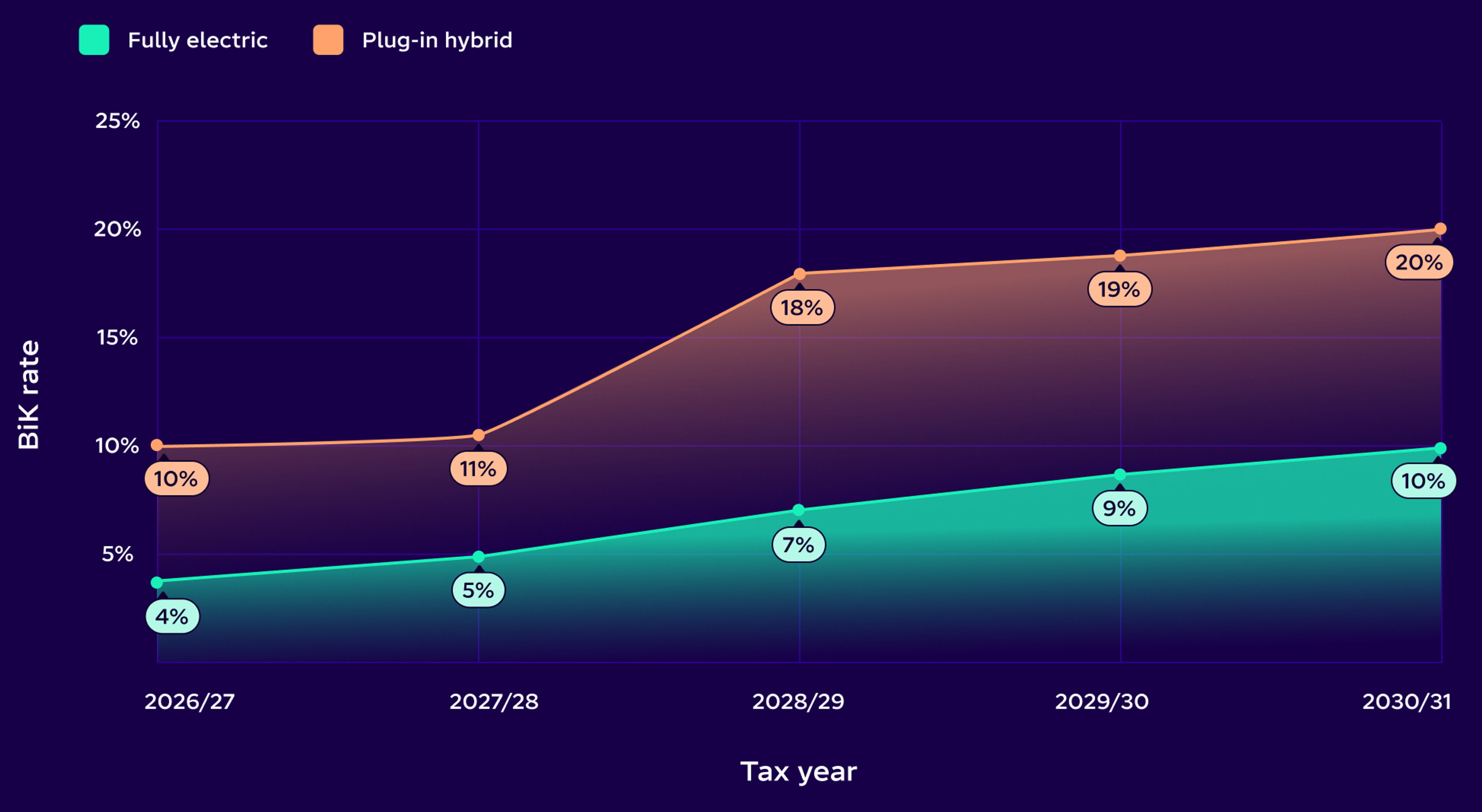
From 2029/30, electric cars will be taxed at 9% of their list price (P11D), every plug-in hybrid will be taxed at 19%, and petrol and diesel cars will be taxed at up to 39% (depending on emissions). Even at 10% in 2030/31, an EV will still be taxed at less than half the top rate petrol and diesel cars reach in 2030/31.
Here’s how the Benefit in Kind rate breaks down for each fuel type:
| 26/27 | 27/28 | 28/29 | 29/30 | 30/31 | |
|---|---|---|---|---|---|
Fully electric: 0g of CO2/km | 4% | 5% | 7% | 9% | 10% |
Plug-in hybrid: 1 to 50g CO2/km 40 to 69 miles range (e.g. MG HS PHEV) | 10% | 11% | 18% | 19% | 20% |
Self-charging hybrid (e.g. Toyota Corolla) | 26% | 26% | 27% | 28% | 29% |
Petrol: 130 to 134g CO2/km (a typical family car) | 32% | 32% | 33% | 34% | 35% |
The 3p per mile charge is going ahead as planned
The electric Vehicle Excise Duty (eVED) starts on 1st April 2028 at 3p per mile for electric cars, rising with inflation from 2029/30. It's designed to help replace fuel duty as more people drive electric. If you have your car with us on salary sacrifice, we’ll include this in your monthly cost, so there's nothing extra to sort out.
Once eVED comes in, the cost of running an electric car is still far lower than a petrol car. At the moment it costs around 18p per mile for petrol, compared with 2p per mile if you charge your EV at home. So you’re still only looking at 5p per mile for electric, vs 18p for petrol. The fundamentals on cheap running costs for electric cars haven’t changed with this Budget.
Everything else that's staying the same
| What | Where it stands |
|---|---|
VAT on home electricity | 0% in Great Britain - extended until 30th July 2027 |
Electric Car Grant | Up to £3,750 off eligible new cars (Band 1), or up to £1,500 (Band 2) |
Road tax | £10 in the first year for electric cars registered from 1st April 2025, then £210 a year (rising in line with RPI). The expensive car supplement applies only above a £50,000 list price. With salary sacrifice, both of these are included in the monthly cost |
Chargepoint grants | Up to £500 a socket for workplaces, and 75% off, up to £500, for renters and flat owners |
Pension salary sacrifice cap | The £2,000 cap from 6th April 2029 applies to pensions only, not cars |
VAT on electricity, Electric Car Grant, vehicle tax rates, Workplace Charging Scheme, home chargepoint grant, pension salary sacrifice reform. Checked 28th October 2026.
How we support your business and your team
Our commitment to transparency isn’t going anywhere. If you run your salary sacrifice scheme with us, your account manager will talk you through what the Budget means for your scheme, so you’re going in with eyes open. And your employees’ quotes will reflect the new rates, so they see the actual monthly cost before they choose a car.
Everything else stays beautifully simple, with our all in one package. The monthly payment covers the car, insurance as standard (as the employer, you can remove this if you prefer), servicing, maintenance, tyres and breakdown cover.
Drivers still choose between a discounted home charger or charging credit, and your HR dashboard keeps the admin in one place.
Common questions
All prices on cars, fuel and charging are correct as of 28th October.